This topic came to mind when we were discussing chronological manipulation and the nature of plot and story in class. A bit of background first-- last year, in Mrs. Turner's English class, I elected to read Cloud Atlas, a book by David Mitchell which was recently developed into a film. It did win several prizes and all that jazz (although so did Wolf Hall), and after reading a brief description, I was hooked.

In short, Cloud Atlas is split into sections which differ in viewpoint. The first section is narrated by Adam Ewing, an incredibly gullible American notary. Halfway through his 'Pacific Journal', though, the section ends mid-sentence and is replaced by a series of 'Letters from Zedelghem', written by Robert Frobisher, a young composer. These literary shenanigans continue, with the only interrupted section being in the middle; subsequently, the stories complete themselves, with the book ending with Ewing's record of his recovery from sickness. Each section proves to be rife with foreshadowing and flashbacks, primarily for use in connecting the sections.
At the time of my reading, I was quite impressed by Mitchell's style. I had never read a book of this sort before, and I found the interweaving chronologies captivating. However, the themes struck me as somewhat uninspired; nothing from the different responses of characters upon encountering evil to the flowery language in the final chapter had particularly interested me.
Then, a fateful moment: looking for the date of publication, I happened to read in the Wikipedia page that the style of Cloud Atlas, which had so drawn me in, was actually almost entirely derived from an earlier work, Se una notte d'inverno un viaggiatore (or, if you prefer, as I do, If on a winter's night a traveler.)
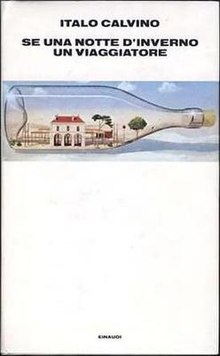
This book is not quite what it seems, and yet it presents its ideas clearly and simply.
(Although I honestly didn't think it was all that possible to spoil Cloud Atlas because of the detailed nature of the different parts, I take a different view of this novel, and so my synopsis will be cursory and nonspecific.)
If on a winter's night a traveler is about the reader-- you! Yes, the greater part is in second person, something that was disconcerting at first, but was clearly demonstrated as a powerful tool in Calvino's capable hands.
Essentially, though the book does involve the splitting of viewpoints, it is quite different in nature (and reading experience) from Cloud Atlas. The latter is exactly as it sounds-- weighty, complex, and just a little difficult to immerse oneself in. By contrast, Calvino's book is much like a puzzle cube. It mimics more common strategies of literature, such as continuity, and then turns them on their heads. The author says to himself, and to the reader-- aha, you didn't expect that, did you?
Reading If on a winter's night a traveler is like playing a game of chess with a Grandmaster. You feel interest, then confusion at a turn of events, mild irritation, and increasing engagement as you try to figure out what is going on; after a while, you feel intense rage at your failure to comprehend what was going on when it first happened, and in the end, you accept your lot in life. You are the reader, and you have just been tricked into reading a book about reading a book.
That being said, I have never met anyone who, after reflecting on the book, did not enjoy it thoroughly. There aren't heavy themes like Cloud Atlas, just a playful demonstration of style. It was genuinely a fun book to read, which was weird, because it was postmodern.
In summary, the manipulation of chronology and continuity can be wonderful literary techniques-- when used by the right authors. To me, Cloud Atlas was overly-ambitious, and though it was a very good read, it did not deliver the revolutionary impact that it had intended to. By contrast, If on a winter's night a traveler knows exactly what it is trying to be. It wasn't a life-changing work; after all, it wasn't intended as such. But it was perfectly tailored to appeal to a careful, thoughtful reader.
To end this post, I'll make a shameless sales pitch! If you haven't ever heard of Calvino, and you enjoy reading, I would highly recommend giving him a try. You won't regret it.
