Searching Google still blew my mind, though.
The obvious symbolism is that of good and evil; however, there is a great deal of underlying similarity to influences ranging from Beowulf to Tolkien's central moral and religious principles. Tolkien was a devout Christian and enthusiastic linguist for much of his life, and so that wasn't a huge surprise. (Fun fact-- Tolkien actually invented the languages first, and wrote the stories to complement them.)
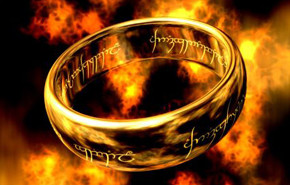 |
| From lotr.wikia.com |
The similarities to Beowulf are mostly shallow in nature. Gollum, and the orcs, are thought to have been inspired by Grendel; likewise, many of the events in The Hobbit and LotR parallel plot points in Beowulf. By contrast, the religious symbolism (I've used that word too many times, but Tolkien repeatedly stated that he hated allegory) is a little more deeply interwoven with the themes.
Some Google searches revealed that several of the characters are actually thought to represent common archetypes in religion, though no one character is a Christ-figure (as in the case of Aslan.)
First, and most evidently, Gandalf. He is introduced as a wanderer, in the form of Gandalf the Grey. He dies in a battle against a Balrog, sacrificing himself to allow the rest of the Fellowship to escape, and is later resurrected. This appears as an immediate parallel to the death and resurrection of Jesus in Christian beliefs.
Aragorn is thought to represent the 'King' aspect. Like Gandalf, he undergoes a transformation, but in his case, it is a change from the inconspicuous ranger Strider to the king of Gondor; this transformation chiefly occurs at a figurative 'death', when he convinces the dead men to fight for him.
The roots of Frodo and Sam, as characters, are subject to quite a bit of debate. Some scholars hold that Frodo represents humanity and Sam represents Jesus (or the Holy Spirit) in a Christian sense; others believe that both represent different types of sacrifice. I find myself more drawn to the second idea; I do not think that the books were intended to represent religion, but rather that they were written by a religious writer, and thus share some thematic similarity. Additionally, sacrifice in and of itself is a motif in all of Tolkien's works. Examples are found throughout the Silmarillion, especially in the case of [Beren and Lúthien], in which the two repeatedly sacrifice things important to them for the sake of the other.
Tolkien also highly developed the mythology of the elves in a way that paralleled Greek mythology. Many of the principal deities resemble Greek counterparts, and like Greek gods, are separate from the idea of creation.
It is quite easy to see that The Lord of the Rings, together with Tolkien's other works, were highly influenced by various mythologies and earlier literature. The central structure of the world of Middle-Earth, and the characters who inhabit it, are expressions of the most basic archetypes of Tolkien's beliefs.
